Why Fence Material Calculator
Planning a fence project sounds simple until you’re standing in the lumber aisle trying to guess how many posts, rails, and pickets you actually need. A fence material calculator takes the guesswork out of the process — and it can save you real time, money, and frustration. Here’s a full breakdown of why it’s worth using one before you buy a single board.
It Prevents Costly Over-Ordering and Under-Ordering
This is the single biggest reason people reach for a calculator. Without one, most people fall into one of two traps:
- Over-ordering: You buy extra “just in case,” and end up with a stack of leftover lumber, half-used concrete bags, and hardware you can’t return. That’s money sitting in your garage instead of in your pocket.
- Under-ordering: You run short mid-project, make a second (or third) trip to the store, and often end up paying rush prices — or worse, discover the store is out of the exact stain-matched boards you started with.
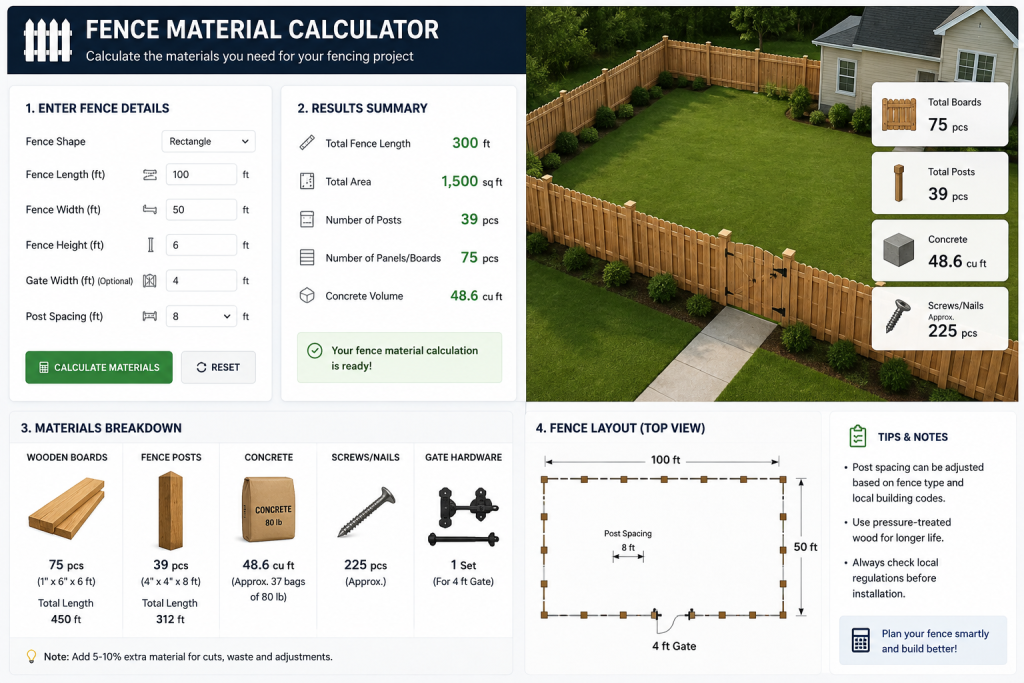
A calculator uses your fence length, height, and style to generate a precise materials list, so you buy close to exactly what the job needs the first time.
It Accounts for Details That Manual Math Misses
Fence math isn’t as simple as “length divided by picket width.” A good calculator factors in variables that are easy to overlook:
- Post spacing — typically 6 to 8 feet apart, but this shifts depending on fence type, panel size, wind exposure, and local soil conditions.
- Corner and gate posts — these usually need to be larger or set deeper than standard line posts because they bear more structural load.
- Picket overlap — privacy fences often use overlapping boards, which increases the picket count beyond a simple linear calculation.
- Rail count by height — a 4-foot fence typically needs 2 rails, a 6-foot fence needs 3, and taller or heavier styles may need 4.
- Concrete volume per hole — based on post hole diameter and depth, which varies by post size and frost line depth in your region.
- Gate hardware and extra bracing — gates need hinges, latches, and often a diagonal brace that isn’t part of the standard run calculation.
Trying to track every one of these variables by hand, especially across a long or irregularly shaped property line, is where most manual estimates fall apart.
It Helps You Budget Accurately Before You Commit
Once you know exact quantities, you can build a real cost estimate instead of a rough guess. This is especially useful when you’re:
- Comparing material types (wood vs. vinyl vs. chain-link vs. aluminum), since price per linear foot varies significantly
- Deciding between styles (privacy vs. picket vs. split-rail), which changes both material count and labor
- Trying to figure out if a full project fits inside a fixed budget before you start
- Getting quotes from contractors and wanting to sanity-check their materials list against your own numbers
A calculator turns “this will cost somewhere between X and Y” into a number you can actually plan around.
It Saves Significant Time on Planning and Shopping
Manually estimating a fence project means sketching your yard, measuring every segment, counting corners and gates, and doing linear-to-unit conversions by hand. A calculator collapses that into a few inputs — total fence length, number of gates, height, and style — and produces a complete shopping list in seconds.
That translates directly into:
- Fewer trips back to the store for forgotten items
- Less time spent second-guessing your own math
- A shopping list you can hand directly to a store associate or contractor
It Reduces Material Waste
Buying the right amount isn’t only about saving money — it also cuts down on waste. Excess lumber often goes unused and eventually gets thrown out or left to weather in a garage. Extra concrete bags harden and become unusable if opened. Precise ordering means less waste heading to a landfill and a more efficient, lower-impact build overall.
It Makes Comparing Fence Styles Easier
Because a calculator recalculates quantities instantly when you change inputs, it’s a fast way to compare options before committing:
- How much more material (and cost) does a 6-foot privacy fence need compared to a 4-foot picket fence?
- Does adding a second gate meaningfully change the total budget?
- Is chain-link significantly cheaper once posts, rail, and fabric are all accounted for?
Instead of redoing manual math for every “what if,” you can test scenarios in seconds.
It’s Useful for More Than Just DIYers
Contractors and fence installers benefit just as much:
- Quickly generating a materials list for a client quote
- Double-checking a supplier’s order against expected quantities
- Avoiding under-ordering on a job site, which can delay a project and hurt a business’s reputation
Bottom Line
A fence material calculator turns a project that’s easy to get wrong into one you can plan with confidence. Whether you’re a homeowner tackling a weekend DIY build or a contractor quoting a job for a client, having accurate numbers upfront means fewer surprises, less wasted material, and a noticeably smoother build from the first post hole to the final picket