
How to Calculate the Total Cost of a Fence
Installing a new fence is one of the most practical investments a homeowner can make. It boosts privacy, improves security, defines property lines, and adds curb appeal. But before you commit to a project, you need a clear picture of what it will actually cost. Fence pricing isn’t a single number — it’s the sum of several moving parts, and understanding each one will help you budget accurately and avoid surprises. This guide breaks down exactly how to calculate your total fence cost, step by step.
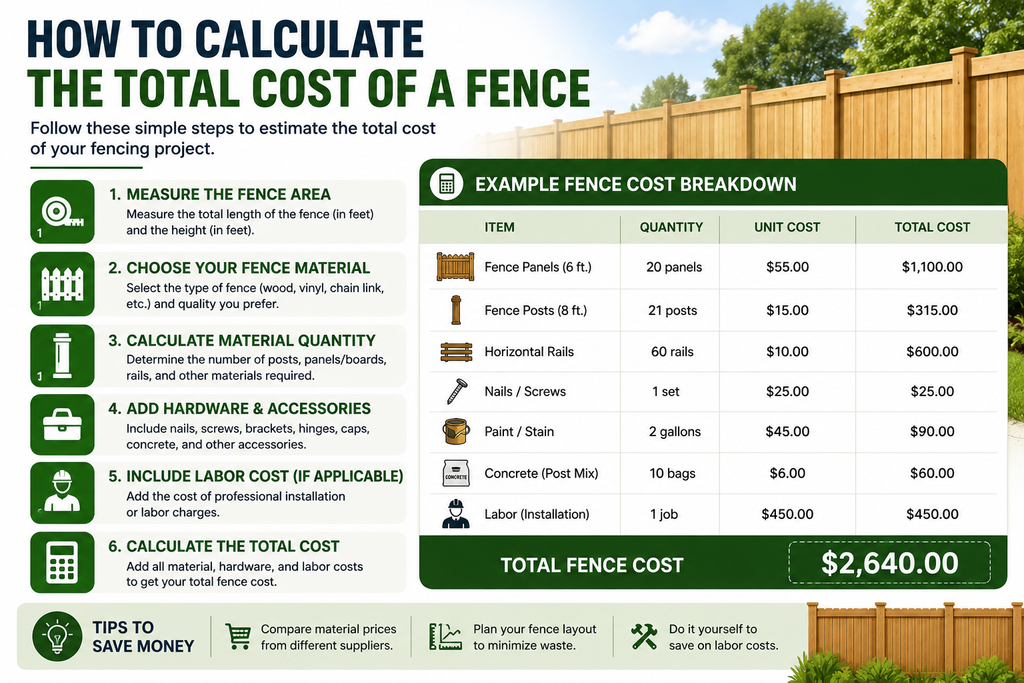
Measure Your Fence Line
The foundation of any fence estimate is linear footage — the total length of fence you need to install, not the square footage of your yard. To calculate this:
- Measure each side of the area you want to fence.
- Add the measurements together to get the total perimeter.
- Subtract the width of any gates, since gates are usually priced separately.
For example, a backyard that measures 100 feet by 60 feet has a perimeter of 320 feet. If you’re only fencing three sides (say, the front is open), subtract the unfenced side from your total.
Choose Your Fence Material
Material choice is the single biggest factor in overall cost. Here’s a general breakdown of average per-linear-foot pricing, including materials and installation:
- Chain link: $10–$20 per linear foot — the most budget-friendly option, ideal for security or containing pets.
- Wood (pine or spruce): $17–$30 per linear foot — a classic look with moderate maintenance needs.
- Wood (cedar or redwood): $25–$40 per linear foot — more durable and rot-resistant, but pricier.
- Vinyl/PVC: $25–$40 per linear foot — low maintenance and long-lasting, with a higher upfront cost.
- Aluminum: $30–$45 per linear foot — decorative, rust-resistant, and common for pool enclosures.
- Wrought iron/steel: $35–$75 per linear foot — premium look and maximum durability, at a premium price.
- Composite: $30–$50 per linear foot — wood-like appearance with less upkeep than real wood.
Multiply your linear footage by the per-foot price range for your chosen material to get a baseline estimate.
Factor in Height
Taller fences require more material and labor, which increases cost. A standard 4-foot fence is the cheapest option, while 6-foot privacy fences (common for backyards) typically add 15–25% to the base price. Fences taller than 6 feet, often used for maximum privacy or security, can add 30% or more.
Add Gates
Gates are priced separately from the fence line itself because they require hinges, latches, and often additional framing. A basic single walk-through gate costs $150–$500 installed, while a wider double-drive gate (needed for vehicles or equipment) can run $500–$1,500 or more, depending on material and whether it’s automated.
Account for Labor
Labor typically makes up 40–60% of your total project cost, though many of the per-foot prices above already include installation. If you’re getting a labor-only quote, expect $5–$15 per linear foot on top of material costs, depending on your region, terrain difficulty, and crew rates. Rocky soil, slopes, or tree roots can increase labor costs significantly because they slow down post-hole digging.
Consider Site Preparation and Extras
Several additional factors can affect your final number:
- Land clearing: Removing brush, old fencing, or debris can add $2–$5 per linear foot.
- Old fence removal: Tearing out and hauling away an existing fence typically costs $3–$10 per linear foot.
- Permits: Many municipalities require a fence permit, which can range from $20 to $400 depending on location.
- Property line survey: If your property boundaries aren’t clearly marked, a survey can cost $200–$800 but prevents costly disputes with neighbors.
- Slope or terrain adjustments: Sloped yards may require stepped or racked fencing, which increases labor time and cost.
Put It All Together
Here’s a simplified formula to estimate your total fence cost:
Total Cost = (Linear Footage × Price per Foot) + Gate Costs + Site Prep + Permits
Example calculation:
- Linear footage: 300 feet
- Material: 6-foot cedar privacy fence at $30/foot = $9,000
- One walk gate: $350
- Old fence removal: 300 feet × $5 = $1,500
- Permit: $150
Estimated total: $11,000
This kind of breakdown lets you see exactly where your money is going, and it makes it much easier to compare quotes from different contractors — or decide which parts of the job you might tackle yourself to save money.
Tips to Save Money on Your Fence Project
- Get at least three quotes from local contractors to compare pricing and scope.
- Choose a mid-range material like pressure-treated wood if premium materials stretch your budget.
- Install during the off-season (late fall or winter in many regions), when contractors often offer lower rates.
- Do some prep work yourself, such as clearing brush, to reduce labor hours.
- Buy materials in bulk if you’re doing a DIY installation, since suppliers often discount larger orders.
FAQs
How much does an average fence cost overall? Most homeowners spend between $1,700 and $6,000 for a standard residential fence, though larger properties or premium materials can push costs well above $10,000.
Is it cheaper to install a fence myself? Yes, DIY installation can save 40–60% of the total cost since you’re only paying for materials, not labor. However, it requires proper tools, physical effort, and accurate measuring to avoid mistakes.
Does fence cost include the gate? Not usually. Gates are typically quoted separately because they need extra hardware and structural support. Always ask contractors whether gates are included in their estimate.
How do I calculate linear feet for a fence? Measure the total perimeter of the area you want enclosed, then subtract any sections you won’t be fencing, such as an existing wall or a side that will stay open.
What’s the cheapest type of fence? Chain link is generally the most affordable option, followed by basic pressure-treated wood. Vinyl and metal fences cost more upfront but often require less long-term maintenance.
Do I need a permit to build a fence? In many areas, yes — especially for fences over a certain height or those near property lines. Check with your local building department before starting the project to avoid fines or forced removal.
How much does it cost to remove an old fence? Removal typically costs $3 to $10 per linear foot, depending on the material and whether the contractor needs to haul away debris.
Final Thoughts
Calculating your total fence cost doesn’t have to be complicated once you break it into its core components: linear footage, material, height, gates, labor, and site preparation. By measuring carefully and getting itemized quotes, you’ll have a realistic budget and the confidence to move forward with a fence that fits both your property and your wallet