
How to Calculate Fence Materials for Your Farm
Fencing a farm is one of those jobs where guessing costs real money. Order too little wire and you’re making a second trip to the co-op mid-project, losing a half-day of work. Order too much and you’ve tied up cash in rolls of wire sitting in the barn. The good news is that fence material math is straightforward once you know the handful of numbers that actually matter: run length, post spacing, strand or rail count, and a waste margin.
The four numbers every fence estimate needs
1. Total fence length. Walk or measure the actual perimeter or run, not the straight-line property boundary — fences follow terrain, and a fence along a hillside or around a pond will run longer than the map distance suggests.
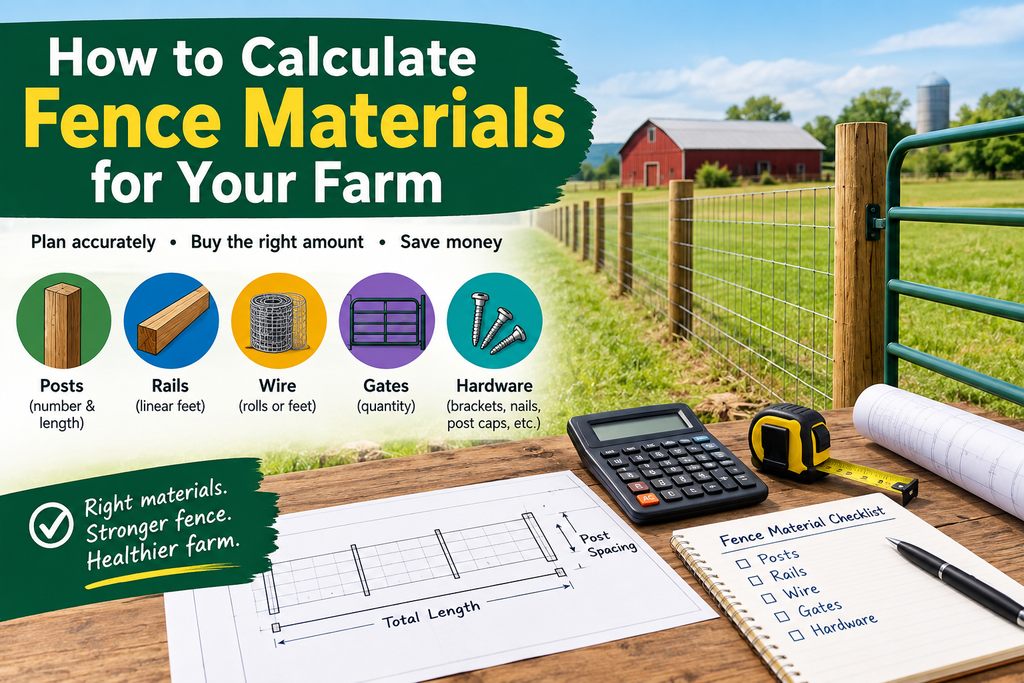
2. Post spacing. This depends on fence type and what you’re containing. Barbed wire and woven wire for cattle typically use 10 to 12 feet between line posts. Horse fencing often tightens up to 8 feet for visibility and safety.
3. Strands or rails per post. A basic cattle barbed-wire fence commonly uses 4 strands. Hog and sheep fencing often needs woven wire plus a strand or two of barbed wire on top. Horse fencing frequently uses 3 to 4 rails or high-tensile electric strands. Wood plank fencing is usually 3 boards high.
4. Waste margin. Always add 3 to 5 percent to your wire or board totals.
Working the math
Once you have those four numbers, the rest is arithmetic:
- Line posts = (total length ÷ post spacing) − 1, rounded to the nearest whole post
- Total posts = line posts + corner/end posts + gate posts (2 per gate)
- Wire needed per strand = total length × (1 + waste %)
- Total wire = wire per strand × number of strands
- Rolls needed = total wire ÷ roll length, rounded up
Woven wire typically comes in 330-foot rolls. Always check the actual roll length printed on what you’re buying — it varies by brand and gauge.
Fasteners and hardware
Don’t forget the small stuff, because it adds up fast on a long run:
- Insulators: required at every post for electric fence, one per strand.
- Gate hardware: 2 hinges and 1 latch per gate is standard, though heavy livestock gates may warrant heavier-duty hinges rated for the gate’s weight.
Corners and bracing
A single corner post with an H-brace or diagonal brace is standard practice for barbed wire and high-tensile fence. Skimping here is the most common reason fences sag within a year or two.
A worked example
Say you’re fencing 1,000 feet of pasture perimeter with 4-strand barbed wire, posts every 10 feet, 4 corner posts, and 1 gate:
- Line posts: (1,000 ÷ 10) − 1 = 99
- Total posts: 99 + 4 + 2 (gate posts) = 105
- Wire per strand with 5% waste: 1,000 × 1.05 = 1,050 ft
- Total wire across 4 strands: 4,200 ft
- Rolls needed (1,320 ft each): 4 rolls (with wire left over for repairs)
- Staples: roughly 99 line posts × 4 strands × 2 = 792, plus extra for corners
That’s the exact calculation the calculator above runs automatically — plug in your numbers and it’ll do this for barbed wire, woven wire, high-tensile electric, or wood rail fencing.
FAQs
How much does it cost to fence one acre of farmland?
Cost depends heavily on the shape of the parcel, fence type, and terrain, but a simple 4-strand barbed wire fence often runs a few dollars per linear foot in materials alone, before labor. A square acre has roughly 835 feet of perimeter, so materials for a basic fence might run into the low thousands of dollars; woven wire and high-tensile electric cost more per foot, and wood rail fencing costs considerably more.
How far apart should fence posts be?
For barbed wire and woven wire cattle fencing, 10 to 12 feet is standard. Wood rail fencing typically matches standard board lengths at 8 feet.
How many rolls of barbed wire do I need per mile?
A mile is 5,280 feet. At a standard 1,320-foot roll length, that’s 4 rolls per strand, per mile. A typical 4-strand fence needs 16 rolls per mile, plus a small waste allowance.
Do I need different post spacing for corners versus line posts?
Corner and end posts aren’t about spacing — they’re about bracing.
How much wire waste should I plan for?
5 percent is a reasonable default for straight runs. Add more — closer to 8 to 10 percent — for fence lines with a lot of corners, hills, or curves, since each corner requires extra wire for wrapping and tensioning.
How many gate hinges and latches do I need?
The standard is 2 hinges and 1 latch per gate, though wider or heavier livestock gates often benefit from a third hinge or heavy-duty hardware rated for the gate’s weight and expected use.
Final Thought
The numbers matter, but so does the order you do things in. Set and brace your corners first — everything else on the fence line depends on them holding tension for the next twenty years, not just the next twenty feet. Once corners are solid, line posts and wire are just repetition: measure once, run the calculator, buy a little extra wire and a few spare staples, and you won’t be the one making a second trip to town halfway through the job.