
What Is a Fence Material Calculator
Building a fence is one of those projects that sounds simple until you’re standing in the hardware store aisle trying to figure out how many posts, rails, and pickets you actually need. That’s exactly the problem a fence material calculator is built to solve.
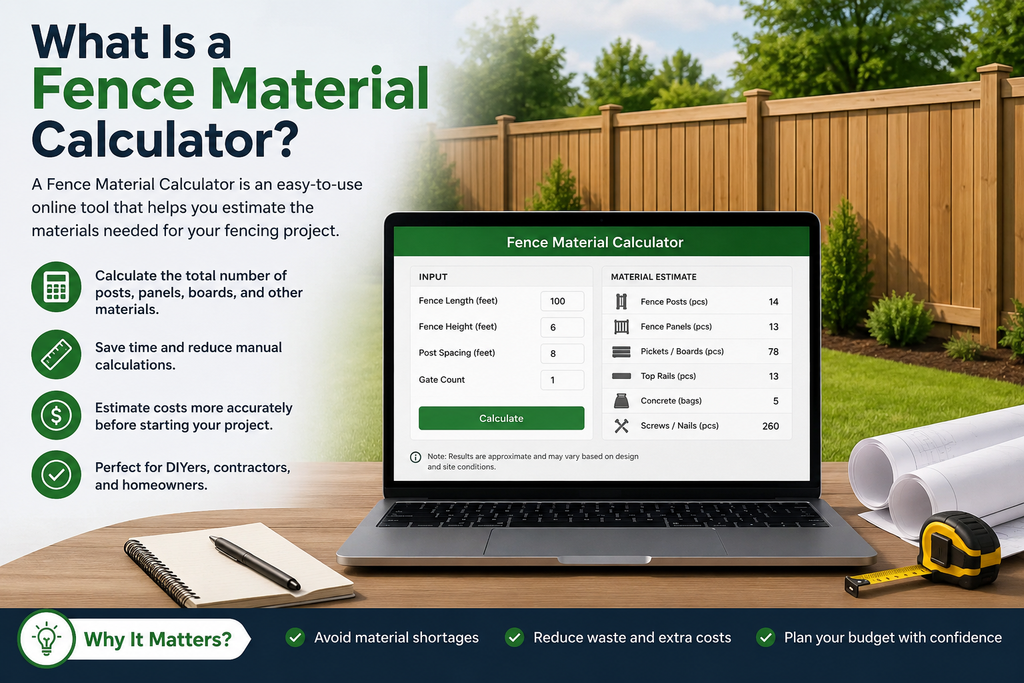
The Basic Idea
A fence material calculator is a tool — usually online, sometimes built into a spreadsheet or app — that takes a few basic measurements of your yard or property line and converts them into a shopping list. Instead of doing the math by hand (and probably getting it wrong the first time), you plug in numbers and get back exact quantities.
What You Typically Enter
Most calculators ask for:
- Total fence length (the perimeter or run you’re fencing)
- Fence height (affects picket/panel size and post height)
- Post spacing (commonly 6–8 feet apart)
- Number of gates and their width
- Fence style (privacy, picket, chain-link, split rail, etc.)
- Number of rails per section (2-rail, 3-rail, etc.)
What It Gives You Back
Based on those inputs, the calculator outputs a materials breakdown, such as:
- Number of fence posts (plus how many bags of concrete to set them)
- Number of rails or stringers
- Number of pickets, panels, or sections of fencing
- Hardware: post caps, brackets, screws/nails, hinges and latches for gates
- Sometimes a rough cost estimate based on local material prices
Why People Use One
- Avoids over- or under-buying — Buying too little means extra trips to the store; buying too much wastes money.
- Saves time on math — Converting a fence run into exact post/picket counts involves several small calculations (spacing, rounding up for corners, accounting for gates) that are easy to mess up manually.
- Helps with budgeting — Seeing the full materials list up front makes it easier to estimate total project cost before starting.
- Useful for both DIYers and contractors — Homeowners use it to plan a weekend project; contractors use it to quickly quote jobs.
A Simple Example
Say you’re fencing a 100-foot run with posts every 8 feet:
- Posts needed: 100 ÷ 8 = 12.5 → round up to 13 posts (plus one extra for the end)
- Rail sections: divided by number of rails per section (e.g., 3-rail fence needs 3x the linear footage in rail material)
- Pickets: based on picket width and desired spacing between them
A calculator automates all of this so you don’t have to redo the arithmetic if you change your mind about height or spacing.
Bottom Line
A fence material calculator turns “I need to fence 100 feet of yard” into a precise list of posts, rails, pickets, concrete, and hardware — cutting down on guesswork, wasted material, and extra hardware store runs