
Fence Material Estimator.
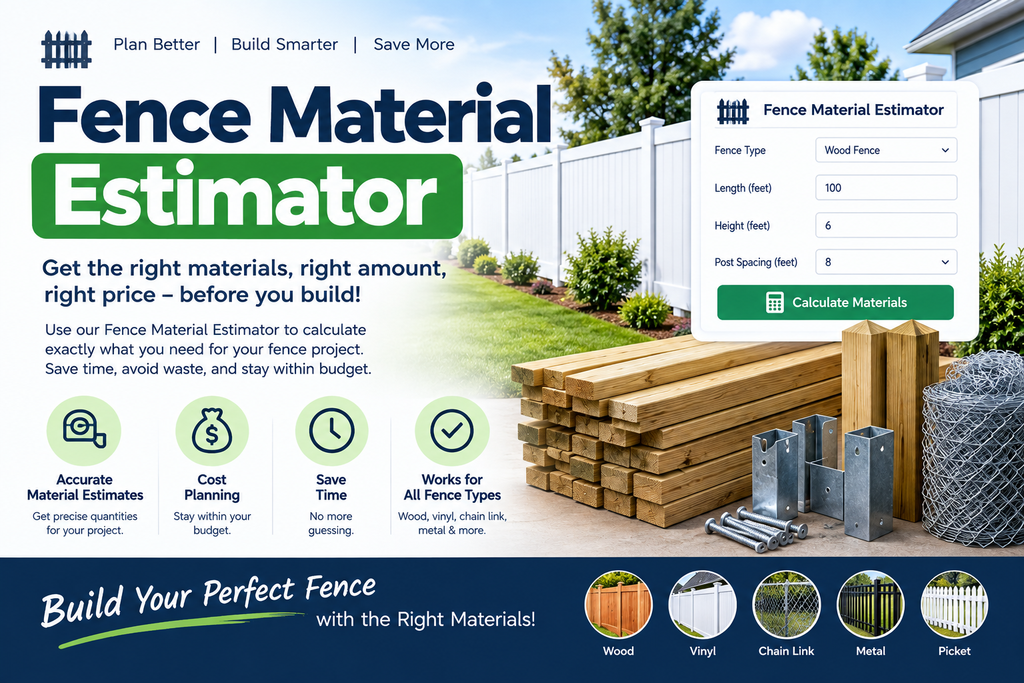
Before you dig a single post hole, one question decides whether your fencing project runs smoothly or turns into a series of frustrating hardware store trips: how much material do you actually need? A fence material estimator answers that question in minutes, turning rough yard measurements into a precise shopping list of posts, rails, panels, and hardware.
This guide explains what a fence material estimator does, the numbers it relies on, and how you can estimate your own project by hand if you’d rather skip the software.
What Is a Fence Material Estimator?
A fence material estimator is a tool — digital or manual — that converts your fence’s dimensions into a complete list of required materials. Instead of guessing how many boards or how many bags of concrete to buy, you input details like total length, height, and material type, and the estimator calculates exact quantities.
This is especially useful for:
- Homeowners planning a DIY fence installation
- Contractors preparing quotes for clients
- Property managers budgeting for multiple fence installations
- Hardware retailers helping customers order the right amount of stock
An accurate estimate prevents two common problems: running out of material halfway through the job, and overbuying materials that sit unused after the project is finished.
Core Factors a Fence Material Estimator Considers
1. Fence Length and Layout The total linear footage of your fence line is the foundation of every calculation. For yards with corners or curves, each straight section should be measured individually and then summed.
2. Fence Style and Height A 4-foot picket fence uses far less material than an 8-foot privacy fence. Taller fences generally require thicker posts, more rails per section, and stronger anchoring to handle wind load.
3. Post Spacing Requirements Spacing directly affects post count — the tighter the spacing, the more posts (and the more stability) your fence will have. Most residential fences use spacing between 6 and 8 feet.
4. Rail Count per Section Privacy and security fences typically use three horizontal rails per section for extra rigidity, while shorter decorative fences may only need two.
5. Gate Openings Gates need dedicated hardware — hinges, latches, and often a heavier gate post on each side — which should be estimated separately from the main fence run.
6. Terrain and Soil Conditions Sloped or rocky terrain can increase both material usage and post-hole depth requirements, since posts may need to be “stepped” or “racked” to follow the ground level.
Step-by-Step Manual Estimation
If you prefer calculating by hand, here’s a straightforward process:
Step 1 — Measure Total Fence Length Walk the perimeter with a measuring wheel or tape, breaking curved or angled sections into straight segments.
Step 2 — Determine Post Count Posts = (Total Length ÷ Post Spacing) + 1
Example: A 150-foot fence line with 7-foot spacing: 150 ÷ 7 = 21.4 → round up to 22, then add 1 = 23 posts
Step 3 — Calculate Rails Sections = Posts − 1 Total Rails = Sections × Rails per Section (2 or 3, depending on style)
Step 4 — Estimate Pickets or Panels For picket fences: divide total length (in inches) by the combined width of one picket plus its gap. For panel fences: divide total length by the standard panel width (commonly 6 or 8 feet).
Step 5 — Concrete for Post Holes Estimate roughly 1.5 bags of concrete mix per standard post hole (10-inch diameter, 24 inches deep), then multiply by total post count.
Step 6 — Add Hardware and Gates Include screws, brackets, hinges, and latches, with extra allowances for each gate opening.
Why Estimating Accurately Matters
Getting your estimate right isn’t just about convenience — it directly affects your budget and project timeline:
- Cost control: Accurate estimates prevent overspending on excess material or emergency top-up purchases at retail prices.
- Time savings: Ordering everything in one trip avoids project delays waiting for a second delivery.
- Waste reduction: Precise numbers mean less leftover material going unused or discarded.
- Better contractor quotes: For professionals, accurate estimates lead to more competitive and trustworthy client pricing.
Common Mistakes to Avoid
- Forgetting the buffer: Always add 5–10% extra material to account for cutting waste and damaged pieces.
- Ignoring terrain changes: Sloped yards often need more posts and adjusted spacing than flat ones.
- Skipping gate calculations: Gates require distinct hardware that’s easy to forget in a bulk estimate.
- Using the wrong post spacing for the material: Vinyl, wood, and chain-link fences each have manufacturer-recommended spacing — using the wrong figure throws off your whole estimate.
- Not checking local codes: Some municipalities have minimum post depth or fence height regulations that affect material needs.
FAQs
Q1: What’s the difference between a fence material calculator and a fence material estimator? They’re largely the same concept — both calculate the quantity of materials needed based on your fence dimensions. “Estimator” is sometimes used to emphasize that the output is an approximate guide, while “calculator” implies a more precise, formula-driven result.
Q2: How accurate is a fence material estimator? When given correct measurements, a good estimator is typically accurate within 5–10%. It’s still wise to add a small buffer for waste, damaged materials, and measurement variance.
Q3: Do I need separate calculations for corners and gates? Yes. Corner posts often require additional bracing, and gates need dedicated posts and hardware that standard line-post calculations don’t account for.
Q4: How much extra material should I order beyond the estimate? A 5–10% buffer is generally recommended to cover cutting waste, defective pieces, and small measurement errors.
Q5: Can a fence material estimator calculate cost as well as quantity? Many estimators include a cost feature, letting you input local material prices per unit to get a total project budget estimate alongside the material quantities.
Q6: What information do I need before using an estimator? At minimum, you need total fence length, desired height, post spacing, material type, and the number of gates. Terrain details help improve accuracy further.
Q7: Is a fence material estimator useful for chain-link fences too? Yes. Chain-link estimators calculate similarly, though they measure fabric rolls per linear foot instead of pickets, and factor in tension wire and end/corner post hardware separately.
Conclusion
A fence material estimator turns a complicated set of measurements into a clear, actionable materials list — saving you money, time, and unnecessary trips to the hardware store. Whether you’re a homeowner tackling a weekend DIY project or a contractor pricing out a job, taking the time to estimate accurately before you buy is one of the smartest steps you can take in the entire