
What Measurements Do You Need for a Fence Material Calculator
Planning a fence and want to know how much lumber, hardware, and concrete to buy? A fence material calculator does the math for you, but it can only be as accurate as the numbers you give it. Here are the measurements you need, why each one matters, and how to gather them.
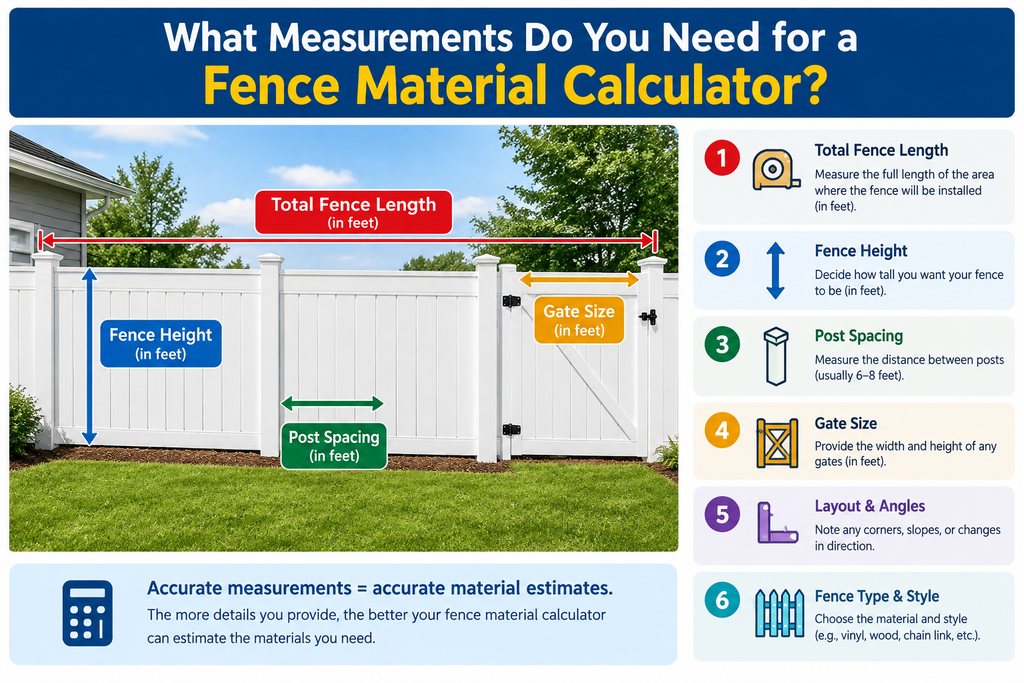
1. Total Fence Length
This is the most important number. Measure the full perimeter where the fence will go, using a long tape measure or a measuring wheel. For larger yards, stake the line with string first so you measure the exact path, not an estimate.
Tip: Measure in a straight line between the points where posts will stand, not along the ground surface if the land is uneven. Fence sections are built level or stepped, so a straight-line measurement is what counts.
2. Number of Corners, Ends, and Direction Changes
Every corner needs its own post, and corner posts often need extra bracing. Count each place where the fence turns, plus each place where it starts or stops. A calculator uses this to adjust your post count, because a fence with many corners needs more posts than a straight one of the same length.
3. Gate Count and Width
Gates change your material list in several ways. Note how many gates you need and how wide each opening should be. A walk gate is typically 3 to 4 feet wide, and a driveway gate is 10 feet or more.
Gates also need sturdier posts on both sides, plus hinges, a latch, and sometimes a drop rod. Subtract the gate width from your total fence length so you don’t buy panels or pickets for the opening.
4. Fence Height
Height affects nearly everything: post length, picket or panel size, and cost. Common residential heights are 4 feet (front yards and pet fences), 6 feet (privacy), and 8 feet (high privacy or security).
Also check your local rules. Many towns limit front-yard fences to 3 or 4 feet and back-yard fences to 6 feet.
5. Post Spacing
Post spacing is the distance between the centers of two posts. Most wood fences use 6 to 8 feet, and many prefab panels are sold in 6 or 8 foot widths. Closer spacing makes a stronger fence but uses more posts, so this setting has a big effect on your total.
Basic formula: Posts = (Fence length ÷ Post spacing) + 1
Always round up, then add extra posts for gates and corners.
6. Post Length and Hole Depth
Posts must be long enough to stand above ground at fence height and sit securely below it. A common rule is to bury about one-third of the post, or at least 2 feet. In cold climates, holes should reach below the frost line to prevent heaving.
So a 6-foot fence typically needs an 8-foot post. Your calculator also needs the hole diameter (often 10 to 12 inches) to estimate concrete.
7. Rail Count per Section
Rails run horizontally between posts and hold pickets or boards. Fences up to about 4 feet tall usually use two rails, while 6-foot fences use three. Multiply the number of sections by the number of rails per section to get your rail total.
8. Picket or Board Width and Gap
For picket or board fences, you need the width of each board and the gap between them.
Formula: Pickets = (Fence length in inches) ÷ (Picket width + gap)
For example, 6-inch pickets with a half-inch gap fit 6.5 inches per picket. Privacy fences use no gap, though wood shrinks, so many installers leave a small one anyway.
9. Slope and Terrain
Hills change your calculations. You can either follow the slope with the fence (called racking) or build it in level steps. Stepping uses taller posts and sometimes extra boards on the downhill side.
Note roughly how much elevation change there is over the run. If the ground is very uneven, give your calculator a little extra material.
10. Waste Factor
Boards split, cuts go wrong, and posts sometimes need replacing. Most calculators add a waste factor of 5% to 10%, and complex layouts with many angles or slopes may warrant more.
A Quick Worked Example
Say you’re building a 100-foot, 6-foot-tall privacy fence with 8-foot post spacing and 6-inch pickets, no gap, no gates:
- Sections: 100 ÷ 8 = 12.5, rounded up to 13
- Posts: 13 + 1 = 14 (8-foot length)
- Rails: 13 × 3 = 39
- Pickets: 1,200 inches ÷ 6 = 200, plus 10% waste = 220
Then add concrete, screws or nails, brackets, and a gate kit if needed.
FAQs
How accurate does my measurement need to be?
Aim for within a few inches over the whole run. Small errors are covered by your waste factor, but large ones can leave you short on posts or panels.
Do I measure the inside or outside of the fence line?
Measure the centerline where the posts will stand. If you’re building near a property line, confirm your boundary first with a survey or your property records.
Should I include the gate in my total length?
Yes, measure the full run, then subtract the gate width when calculating panels or pickets. Add the gate hardware separately.
How many bags of concrete do I need per post?
It depends on hole size and depth. As a rough guide, many 4×4 posts in 10-inch holes use one to two 50-pound bags. Your calculator or the product label gives a more exact figure.
Does post spacing have to be 8 feet?
No. Six feet gives extra strength for tall or windy areas, and 8 feet saves money. Check your rail and panel sizes first, since they often dictate the spacing.
What if my yard has a slope?
Measure the run in a straight line, note the elevation change, and choose racking or stepping. Order extra material to handle the angle.
Do I need a permit?
Often, yes. Many areas require permits or limit fence height and placement, so check with your local building office before you buy anything.
What’s the biggest mistake people make?
Forgetting gates, corners, and waste. Those are the items that most often leave a project short on materials.
The Bottom Line
To get a reliable estimate, gather these numbers before you use a fence calculator: total length, corners and ends, gate count and width, fence height, post spacing, post depth, rail count, picket width and gap, slope, and waste allowance. Measure twice, add a small buffer, and you’ll avoid the extra trips to the hardware store.