
How to Calculate Wood Fence Materials
Building a wood fence is one of those projects where the actual construction is often easier than getting the math right beforehand. Order too little material and you’re stuck with mismatched lumber from a second trip to the store. Order too much and you’ve wasted money. Here’s a step-by-step method for calculating.
ng exactly what you need.
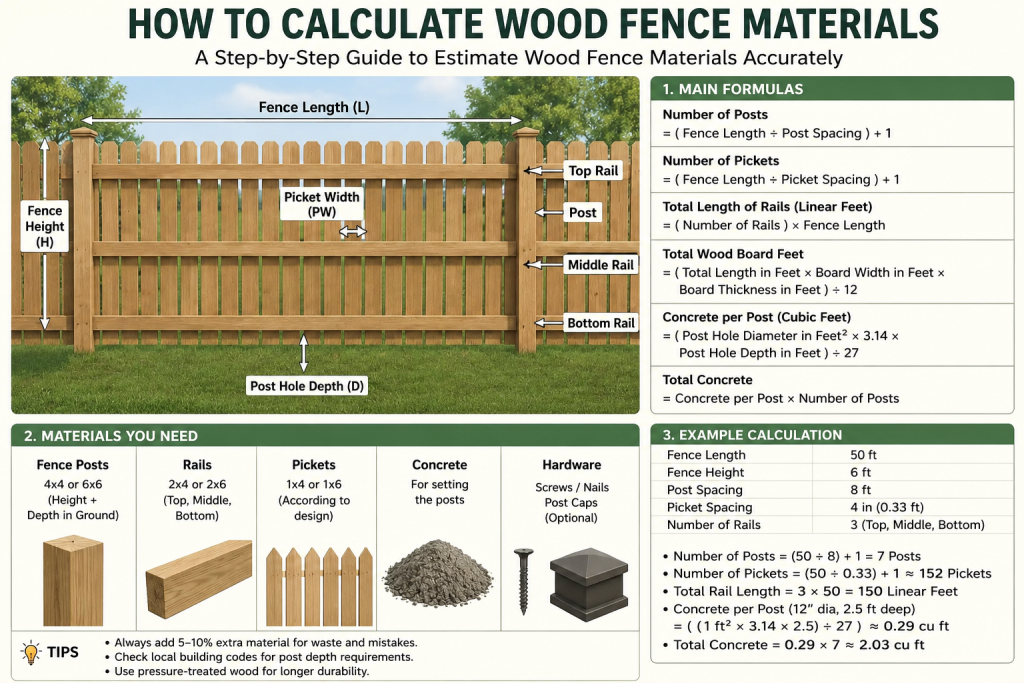
Step 1: Measure Your Fence Line
Walk the perimeter of the area you’re fencing and measure each straight run in feet. Add up all the runs to get your total linear footage. If the line has corners, measure each segment separately and add them together.
Don’t forget to subtract the width of any gate openings — you’ll calculate those separately.
Step 2: Determine Post Spacing
Post spacing depends on the fence style and the size of your rails, but 8 feet on-center is the standard for most residential wood fences. Some styles (like heavy privacy fences or areas with high wind) use 6-foot spacing for extra strength.
Formula for number of posts:
Number of posts = (Total linear footage ÷ post spacing) + 1The “+1” accounts for the final post at the end of a straight run. If your fence has corners, add one extra post for each corner, since corner posts do double duty and are usually set separately from the count above.
Example: A 120-foot fence with 8-foot spacing: 120 ÷ 8 = 15, plus 1 = 16 posts
Step 3: Calculate Post Depth and Concrete
A good rule of thumb is to bury 1/3 of the post length in the ground, with a minimum of 24 inches for a standard 6-foot-tall fence. So an 8-foot post gets about 2.5–3 feet underground.
For concrete, a typical post hole (10-inch diameter, 2.5 feet deep) takes roughly 1.5 bags of 50-lb quick-set concrete per post. Multiply by your post count, then round up.
Step 4: Calculate Rails
Rails run horizontally between posts and support the pickets or boards. Most privacy and picket fences use 2–3 rails per section (top, middle, bottom); taller fences (6+ feet) often need 3.
Number of rails = Number of sections × rails per sectionWhere “sections” = number of posts minus 1 (for a straight run) or total post-to-post spans if there are corners.
Example: 15 sections × 3 rails each = 45 rails (typically 2x4s cut to your post-spacing length, e.g., 8 feet).
Step 5: Calculate Pickets or Fence Boards
This depends on board width and whether you want gaps between boards (board-on-board or spaced picket) or a tight privacy fence.
Boards needed = (Total linear footage × 12) ÷ (board width + gap width, in inches)Example: A 120-foot privacy fence using 6-inch boards with no gap: 120 ft × 12 in = 1,440 inches 1,440 ÷ 6 = 240 boards
If you want a small gap (say, 1/2 inch) for airflow, add that to the divisor: 6.5 inches per board instead of 6.
Step 6: Add Hardware and Fasteners
- Post caps — one per post (optional but recommended for weatherproofing)
- Galvanized screws or nails — estimate 2–3 lbs per 100 sq. ft. of fencing for rail-to-post connections, plus extra for picket attachment
- Post brackets or joist hangers — if using a bracket system instead of notching rails into posts, you’ll need 2 brackets per rail end
Step 7: Account for Gates
For each gate, you’ll need:
- 2 heavier posts (gate posts are often larger, e.g., 6×6 instead of 4×4)
- Hinges (2–3 per gate, depending on weight)
- A latch or lock set
- Extra bracing (a diagonal brace on the gate frame prevents sagging)
Step 8: Add a Waste Factor
Always order 10% extra on boards and rails to cover cutting errors, warped lumber, and future repairs. For posts and concrete, a 5% buffer is usually enough since there’s less cutting involved.
Quick Reference Summary
| Material | Formula |
|---|---|
| Posts | (Linear ft ÷ spacing) + 1 + corners |
| Concrete | ~1.5 bags per post |
| Rails | Sections × rails per section |
| Boards/Pickets | (Linear ft × 12) ÷ (board width + gap) |
| Fasteners | ~2–3 lbs per 100 sq. ft. |
| Waste factor | +10% boards/rails, +5% posts/concrete |
With these numbers in hand, you can build a full materials list and get an accurate quote before you ever set foot in the lumber aisle.