Is It Cheaper to Install a Privacy Fence Yourself
If you’ve started pricing out a privacy fence, you’ve probably noticed the numbers are all over the place. That’s because “cheaper” depends heavily on what you’re comparing — DIY materials alone, DIY plus your time, or a fully installed professional job. Here’s a clear breakdown of the real 2026 numbers, so you can decide what actually makes sense for your yard and your wallet.
The Short Answer
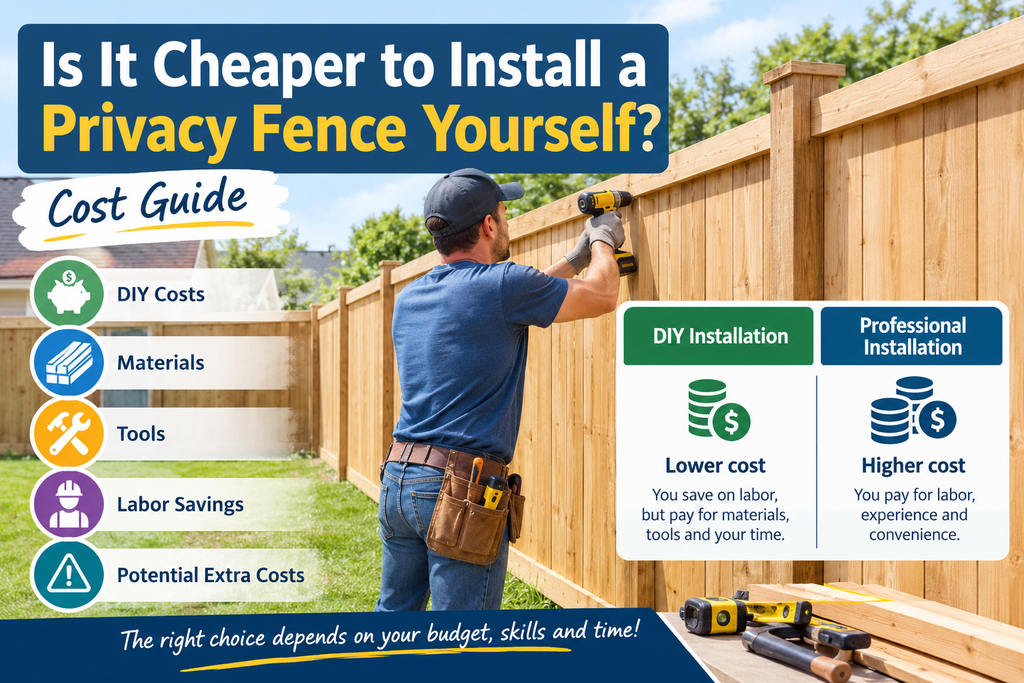
Building it yourself is almost always cheaper up front — typically by 30% to 50% — but the savings shrink once you account for tools, mistakes, physical effort, and the time it takes. DIY material costs generally run $15 to $45 per linear foot depending on material, while professional installation adds another $15 to $35 per linear foot for labor. So on the same fence, you might pay $20/ft doing it yourself versus $50/ft hiring it out — a real difference, but not free money. barrierbossusa
What DIY Actually Costs
National average hired-out privacy fencing runs $25 to $55 per linear foot installed, while DIY material costs run $15 to $30 per linear foot for materials — a 40% to 60% savings on labor.
Here’s how that breaks down by material, based on a standard 6-foot privacy fence:
| Material | DIY (Materials Only) | Fully Installed (Pro) | Lifespan |
|---|---|---|---|
| Pressure-treated wood | $10–$18/ft | $25–$40/ft | 10–15 years |
| Cedar | $15–$25/ft | $30–$50/ft | 15–20 years |
| Vinyl | $17–$30/ft | $28–$55/ft | 20–30 years |
| Composite | $20–$35/ft | $35–$60/ft | 25–30 years |
| Metal (coated steel) | $15–$30/ft | $28–$50/ft | 40+ years |
Figures reflect standard 2026 pricing for a 6-foot-tall privacy fence.
For a typical 150-linear-foot backyard, that puts DIY materials somewhere around $2,250–$4,500, versus $3,750–$8,250 for a full professional install — consistent with broader industry data putting privacy fences at $31.50 to $53.50 per linear foot including materials and labor, or $4,725 to $8,025 for a 150-foot fence.
What You’re Actually Saving On (and What You’re Not)
The gap between DIY and hiring out is almost entirely labor. Installation in 2026 runs $25 to $55 per linear foot hired out, versus $15 to $30 in materials alone if you do it yourself. That labor line covers things that matter more than they look like on paper: barrier bossusa
- Digging and setting posts — the single most physically demanding and highest-stakes part of the job. Posts set too shallow, unlevel, or without proper concrete curing will make the whole fence lean or fail early.
- Getting fence lines straight and square over long distances, especially on sloped or uneven yards.
- Navigating permits and property lines — a mistake here can mean tearing the fence out and starting over.
- Speed — a typical 150-linear-foot yard takes 2 to 4 days for an experienced DIYer with a helper, and inexperienced first-timers often take longer.
If any of those feel outside your comfort zone, the “pro” price isn’t just paying for labor — it’s paying to not redo the project.
Hidden Costs That Change the Math
A few things routinely get left out of DIY budget estimates and can eat into the savings:
- Tool rental or purchase. A post hole digger or one-person auger, a level, a drill/impact driver, and a string line aren’t free if you don’t already own them.
- Concrete and hardware. These add up fast across dozens of posts and are easy to underestimate.
- Permit fees. Permit and code costs can range from $0 to $140 depending on the city, with some jurisdictions requiring permits for fences over a certain height.
- Mistakes. Miscut boards, a post set in the wrong spot, or a line that isn’t square can mean buying extra material.
- Your time. Even a fast DIY job eats a couple of full weekends. If your time has real financial value to you (missed overtime, a side gig, etc.), that’s worth factoring in.
When Buying (Hiring Out) Makes More Sense
- Your yard has slopes, rocky soil, tree roots, or other terrain that complicates post-setting
- You want a warranty on workmanship, not just materials
- You’re installing a tall or heavy fence (8 ft+, masonry, or large composite panels) where mistakes are costly to fix
- You don’t have the time for a multi-day weekend project
- Local permitting or HOA rules are complex and you’d rather a contractor handle compliance
When Building (DIY) Makes More Sense
- You’re working with a simpler material like pressure-treated wood or basic metal panels
- Your yard is flat and easy to measure and square
- You’re comfortable with basic tools and have a helper for two hands on heavy posts
- You’re fencing a shorter run (under 150 ft) where the labor savings are proportionally larger
- You’re not in a rush and can spread the work over a couple of weekends
FAQs
Is it really 50% cheaper to build a privacy fence yourself?
Roughly, yes, on the labor side. Metal privacy panels, for example, run about $25–$40 per linear foot installed, while DIY material costs sit around $25–$40/ft with labor add-ons separately quoted at $15–$35/ft — meaning labor alone often accounts for 30–50% of the total project cost. barrierbossusa
What’s the single biggest mistake DIYers make?
Improper post depth and spacing. Posts that aren’t set deep enough or in properly cured concrete are the top reason DIY fences fail early or lean over time — and fixing this after the fact usually costs more than doing it right the first time.
Do I need a permit to build a privacy fence?
Some jurisdictions require permits for fences above certain heights or in planned developments, so it’s worth checking your local rules before you buy materials, regardless of whether you DIY or hire out.
Which material offers the best value over time?
Metal (dip-coated steel) fencing lasts 40+ years with zero maintenance, while pressure-treated wood lasts 10–15 years and needs staining or sealing every 2–3 years. If you’re optimizing for lowest lifetime cost rather than lowest upfront cost, metal or vinyl often wins despite a higher initial price.
How long does a DIY privacy fence take to install?
Most homeowners can expect 1–2 weekends, or roughly 16–24 hours of actual work, for a typical 150-linear-foot yard — longer if it’s your first time or the terrain is uneven.
Can I do a hybrid approach — DIY some parts, hire out others?
Yes, and it’s a common middle ground. A frequent approach is hiring a pro to set posts correctly (the highest-risk step) and then doing the panel or board installation yourself, which cuts labor costs while reducing the risk of a structurally unsound fence
Final Thought
There’s no universal right answer here — only the right answer for your yard, your budget, and how much your weekends are worth to you. If you’re handy, have flat ground, and don’t mind a couple of long days with a post hole digger, DIY will save you real money and hand you a fence you built with your own hands. If your property throws curveballs — slopes, rocky soil, strict HOA rules, or a premium material where a mistake is expensive to undo — paying for professional labor isn’t really an extra cost. It’s insurance against having to redo the job twice.