How to Calculate Materials for a Wood Fence
Building a wood fence is one of the most rewarding DIY projects a homeowner can take on—it boosts curb appeal, adds privacy, and increases property value. But before you swing a single hammer, you need to know exactly how much material to buy. Underestimate, and you’ll be making frustrating extra trips to the lumber yard. Overestimate, and you’re wasting money on materials you’ll never use. That’s where a wood fence material calculator becomes essential.
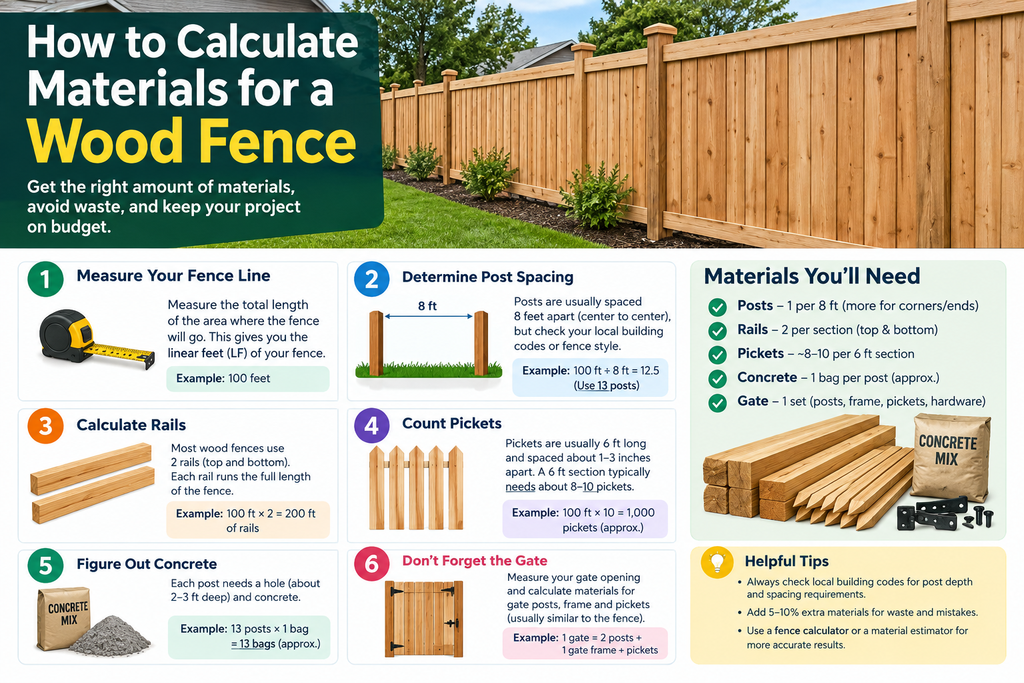
This guide walks you through exactly what goes into calculating your fence materials, so whether you use an online calculator or do the math yourself, you’ll understand precisely what you’re buying and why.
Why Accurate Material Calculations Matter
Wood fencing isn’t cheap, and lumber prices fluctuate constantly. A miscalculation of even 10-15% on a 150-foot fence line can mean hundreds of dollars in wasted materials or costly delays waiting on backordered lumber. Getting your numbers right the first time saves money, time, and the headache of mismatched wood grain or color from a second supplier run.
The Core Components You Need to Calculate
Every wood fence, regardless of style, is built from the same basic components. A good calculator—or your own math—needs to account for each one.
1. Posts
Posts are the backbone of your fence. To calculate how many you need:
- Measure your total fence length in linear feet.
- Decide on post spacing, typically 6 to 8 feet apart. Shorter spans are sturdier but require more posts and cost more; longer spans save money but risk sagging over time.
- Formula: Total fence length ÷ spacing + 1 = number of posts.
For example, a 120-foot fence with 8-foot spacing needs 15 posts (120 ÷ 8 = 15, plus 1 for the starting post).
Don’t forget to add posts for gates, corners, and end points, since these often require heavier-duty posts than standard line posts.
2. Post Depth and Concrete
Posts typically need to be buried at roughly one-third of their above-ground height, with a minimum depth of 24 inches in most climates (deeper in areas with significant frost heave). Each post hole generally requires 1.5 to 2 bags of concrete, depending on hole diameter.
3. Rails (Horizontal Support Boards)
Rails run horizontally between posts and support the fence pickets or panels. Most privacy fences use two or three rails per section (top, middle, and bottom), while taller fences may need more for structural stability.
Formula: Number of post-to-post sections × rails per section = total rail count. Rails are usually purchased in 8, 10, 12, or 16-foot lengths, so factor in how many rail boards fit your specific spacing without excessive waste.
4. Pickets or Fence Boards
This is where most of your lumber budget goes. To calculate pickets:
- Determine your picket width (commonly 5.5 inches for dog-ear pickets) and desired gap (if any) between boards.
- Formula: Fence length (in inches) ÷ (picket width + gap width) = number of pickets needed.
For a solid privacy fence with no gaps, simply divide the total linear footage by the picket width. For a board-on-board or shadowbox style, you’ll need roughly 1.5 times the standard picket count since boards overlap.
5. Fasteners
Don’t overlook hardware. You’ll need:
- Galvanized or coated deck screws/nails (roughly 4-6 fasteners per picket connection point)
- Post caps
- Hinges and latches for gates
- Concrete mix for post setting
6. Gates
Measure gate openings separately, as they require additional hardware (hinges, latches, drop rods) and often heavier framing than standard fence sections.
Sample Calculation Walkthrough
Let’s say you’re building 100 linear feet of 6-foot privacy fence with 8-foot post spacing:
- Posts: 100 ÷ 8 + 1 = 13 posts (round up to account for corners)
- Concrete: 13 posts × 2 bags = 26 bags
- Rails: 12 sections × 3 rails = 36 rail boards
- Pickets: 100 feet (1,200 inches) ÷ 5.5 inches ≈ 218 pickets
- Fasteners: 218 pickets × 4 screws ≈ 872 screws, plus extra for rails and posts
Always add a 10% buffer to your picket and rail counts to account for cutting errors, warped boards, or future repairs.
Tips for Using an Online Calculator Effectively
- Measure twice: Walk your fence line with a tape measure or measuring wheel rather than estimating from a property survey, since actual terrain can differ.
- Account for slopes: Sloped yards may require stepped or raked fence panels, which changes material needs.
- Factor in local codes: Some municipalities require specific post depths or fence heights, which affects both material and cost.
- Choose your wood type first: Cedar, pine, and redwood have different standard board dimensions and price points, which calculators use to generate accurate cost estimates.
FAQs
How much wood do I need for a 100-foot fence?
For a standard 6-foot privacy fence, you’ll typically need around 13 posts, 36 rail boards, and 200-220 pickets, plus roughly 25-30 bags of concrete. Exact numbers depend on post spacing and picket width.
What is the standard spacing between fence posts?
Most wood fences use 6 to 8-foot post spacing. Tighter spacing (6 feet) adds strength and is recommended for taller fences or high-wind areas, while 8-foot spacing reduces material costs for standard privacy fences.
How deep should fence posts be buried?
A general rule is to bury one-third of the post’s total length, with a minimum of 24 inches. In colder climates, posts should be set below the frost line—often 36 to 48 inches—to prevent heaving.
How many bags of concrete do I need per post?
Most 4×4 or 6×6 posts require 1.5 to 2 bags of 50-pound concrete mix per hole, depending on hole diameter (typically 10-12 inches) and depth.
Should I buy extra materials beyond the calculator’s estimate?
Yes, industry standard practice is to add a 10% buffer for pickets and rails to cover cutting waste, defective boards, and future repairs.
What’s the difference between calculating for a privacy fence versus a picket fence?
Privacy fences use tightly spaced or overlapping boards with no gaps, requiring significantly more pickets per linear foot than a traditional picket fence, which has visible spacing (often 2-4 inches) between boards.
Do gates require separate material calculations?
Yes. Gate sections need additional framing lumber for structural rigidity, plus hardware like hinges, latches, and sometimes drop rods, which aren’t included in standard per-foot calculations.