
Planning a Picket Fence
A picket fence is one of the few home improvements that pays off in curb appeal almost the day it goes up, and it’s also one of the most forgiving projects for a first-time builder. The geometry is simple, the tools are ordinary, and mistakes are easy to fix before the concrete sets. Where people usually go wrong isn’t the carpentry — it’s the shopping list. Buy too few posts and a Saturday project stalls for a week waiting on a lumber run. Buy too many pickets and you’ve paid for offcuts headed for the burn pile. This guide walks through how to measure your line, choose materials, and turn those numbers into an accurate order.
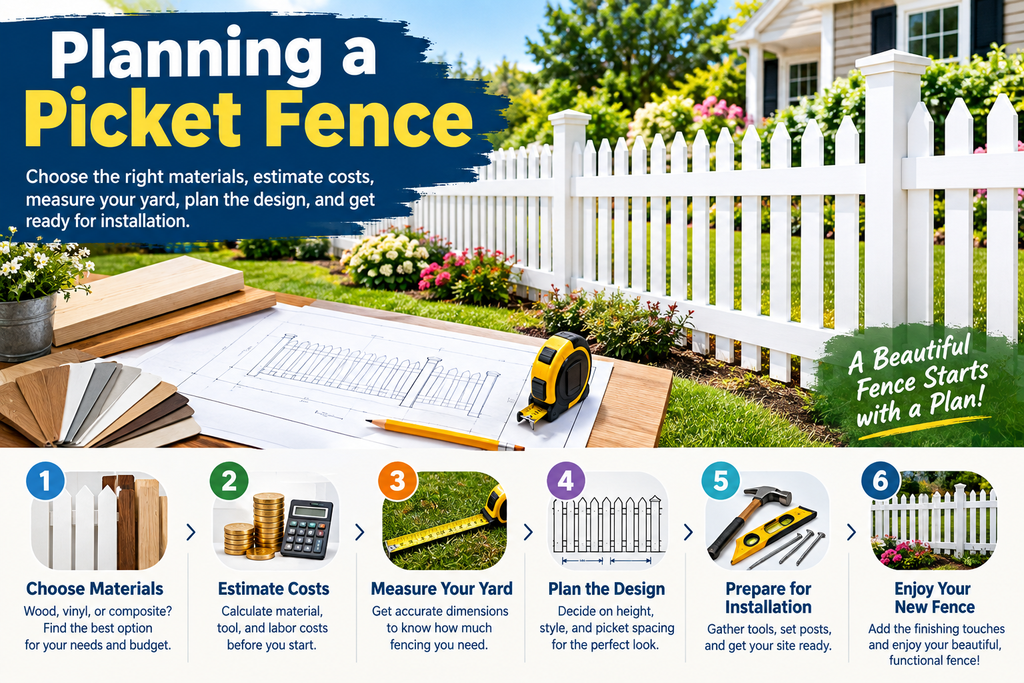
Start With the Fence Line, Not the Fence
Before anything else, walk the property line with a tape measure or measuring wheel and record the true run in feet, including any turns or offsets as separate segments. Note slopes, tree roots, and existing structures, since these affect post spacing more than they affect the design itself. If the line crosses a slope, you’ll either step the fence down in short level runs or rack the pickets to follow the grade — racked pickets keep a constant gap along a slope, while stepped sections keep the top rail level in short flat runs. Decide which look you want now, since it changes how you divide the run into sections.
Call 811 (or your local utility locate service) before digging any post holes. It’s free, it’s required in most places, and it’s the single most common thing DIYers skip until a shovel meets a gas line.
Choosing Post Spacing
Post spacing is the backbone of the whole material list, because every other quantity — rails, concrete, digging — scales off the number of posts. Most picket fences use 6 to 8 feet between posts. Shorter spans mean a stiffer, straighter fence that resists sagging over time, but more posts, concrete, and digging. Longer spans save on posts but ask more of your rail lumber, which can bow under its own weight over a few years unless you upsize it.
| Spacing | Best for | Trade-off |
|---|---|---|
| 6 ft | Uneven or sloped ground, exposed sites | More posts and concrete |
| 8 ft | Standard flat-yard picket fence | Balanced cost and rigidity |
| 10 ft | Budget runs on flat, sheltered ground | Needs thicker rails to avoid sag |
Picket Width, Gap, and Order Quantity
Classic picket fences use pickets between 2.5 and 4 inches wide with a gap roughly two-thirds of the picket width — tight enough to read as a solid line from the street, open enough to let air and light through. A 3.5-inch picket with a 2.5-inch gap is the traditional proportion seen on older American houses; going wider on the gap reads more modern and uses noticeably fewer pickets per foot, which matters if your budget is tight.
Materials: Wood, Vinyl, or Composite
Pressure-treated pine is the default for posts and rails because it resists rot in ground contact and is inexpensive nearly everywhere. For visible pickets, many builders step up to cedar or redwood, which hold paint and stain better and resist cupping. If upkeep matters more than upfront cost, cellular vinyl or composite picket systems cost more per foot but need no repainting and won’t splinter or rot — though they come in fixed panel widths, so your spacing has to match the manufacturer’s system rather than a custom layout.
- Pressure-treated pine — cheapest, needs sealing/staining every 2–3 years, rated for ground contact on posts.
- Cedar / redwood — naturally rot- and insect-resistant, takes paint beautifully, costs roughly 1.5–2× pine.
- Vinyl / composite — highest upfront cost, essentially zero maintenance, sold as pre-spaced panel kits.
Posts, Concrete, and Setting Depth
A good rule of thumb for post depth is one-third of the post’s above-ground height, with a minimum of 24 inches in most soils — so a 4-foot fence typically wants posts set about 24 to 30 inches deep. Gate posts carry more load from swinging and slamming, so it’s common to use a heavier 6×6 post there, set a few inches deeper, even when the rest of the line uses 4×4s. Two 50-lb bags of fast-setting concrete comfortably fill a 10-inch-wide, 24-inch-deep hole around a 4×4 post; larger holes or gate posts often take three to four bags.
Most first-time fence builders underestimate posts and overestimate pickets — get the post count right first, and the rest of the order follows from it.
Rails and Fasteners
Two horizontal rails per section (top and bottom) is standard for fences up to about 4 feet tall; taller fences, or anywhere the fence needs extra racking strength, benefit from a third mid-height rail. Rails run post-to-post, so their count is simply the number of sections multiplied by rails-per-section. For fasteners, exterior-rated deck screws outlast nails significantly and won’t work loose from seasonal wood movement — budget two screws per picket-to-rail contact point, and two to three per rail-to-post connection.
Putting It Together
Once you know your total run, spacing, height, picket dimensions, and gate count, the order writes itself: posts come from length divided by spacing, rails come from post count times rails-per-section, and pickets come from total length divided by picket-plus-gap width. Add a 10% waste allowance across the board to cover miscuts, warped boards, and the occasional split picket, and you’ll rarely need a second trip to the lumberyard.
FAQs
How many pickets do I need per linear foot?
Divide 12 inches by the sum of your picket width and the gap between pickets. A 3.5-inch picket with a 2.5-inch gap uses 6 inches of run per picket, so that’s 2 pickets per foot — 200 pickets for a 100-foot fence, before waste.
What’s the right depth for fence posts?
A common rule is one-third of the post’s height above ground, with at least 24 inches minimum.
Should I use 4×4 or 6×6 posts?
4×4 posts are standard for line posts up to about 5 feet tall. Gate and corner posts take more lateral stress and are usually upsized to 6×6.
How much concrete does one post need?
For a typical 4×4 in a 10-inch by 24-inch hole, two 50-lb bags of fast-setting concrete is a reasonable estimate. Gate posts often need three to four bags.
Can I space posts more than 8 feet apart?
You can, but rails will need to be upsized (2×6 rather than 2×4) to resist sagging over a longer span, and the fence will feel less rigid.
Do I need a permit to build a picket fence?
It depends on your municipality and fence height — many places allow fences under 4 feet in front yards without a permit, but rules vary widely. Check with your local building department, and always call 811 first.
How much waste allowance should I buy?
10% is a comfortable default for flat, straight runs. Bump to 15% if your line has a lot of turns or slopes that require racking or stepping.
Want this saved as a Word doc or Markdown file you can drop straight into a CMS?
Final Thought
A picket fence is a small project with a big payoff — it’s often the first thing anyone sees of your home, and it rarely takes more than a weekend or two once the materials are on-site. The math behind it isn’t complicated, but getting it right up front saves you from the two most common headaches: a stalled project waiting on a mid-build lumber run, or a pile of leftover pickets nobody needed. Measure the line carefully, pick a post spacing that fits your ground, and build in a modest waste allowance — the rest of the order follows almost automatically. Get the posts right, and the fence takes care of itself.