
How Does It Estimate Fence Panels
Planning a fencing project can feel overwhelming once you move past picking a style and start thinking about materials. One of the most common questions homeowners and contractors ask is simple but important: how does a fence panel estimator actually calculate how many panels I need? Whether you’re using an online calculator, a mobile app, or getting a quote from a fencing company, the underlying math is largely the same. Understanding it helps you double-check quotes, avoid over-ordering, and plan your budget with confidence.
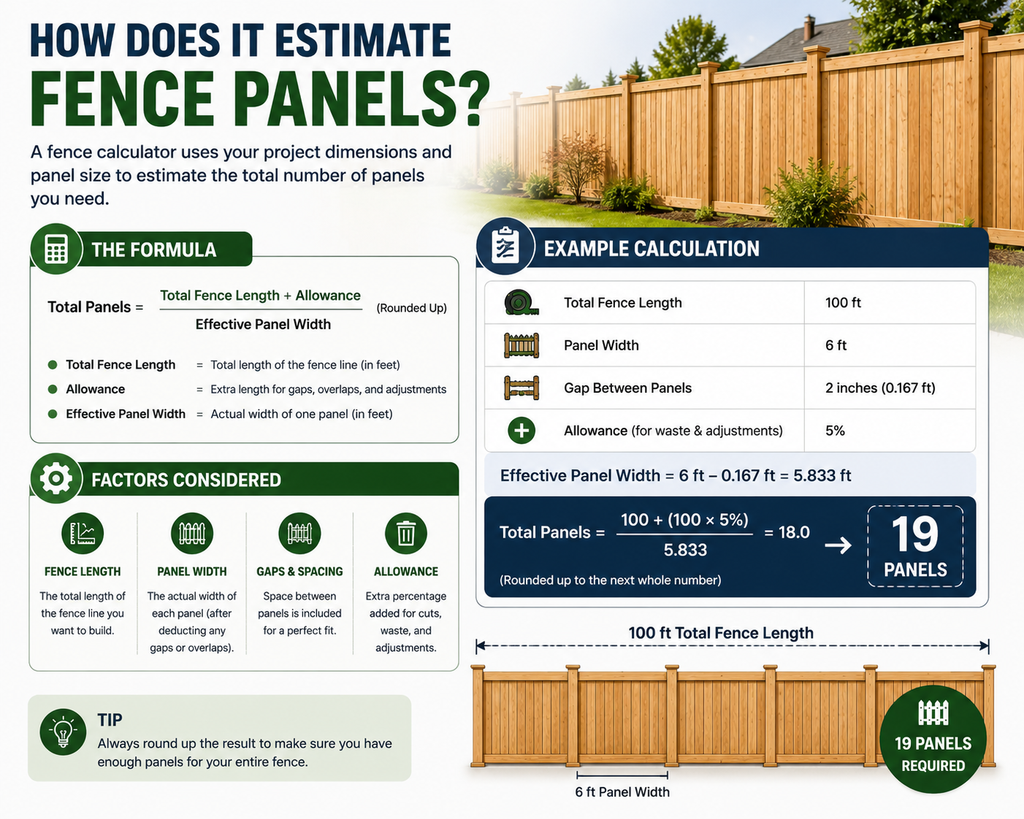
The Basic Formula Behind Fence Panel Estimation
At its core, a fence panel estimate is built on one simple relationship:
Total Fence Length ÷ Panel Width = Number of Panels
For example, if you’re fencing a yard with a perimeter of 200 feet, and each fence panel is 8 feet wide, the calculation is straightforward: 200 ÷ 8 = 25 panels. But real-world estimators rarely stop there, because very few properties have perfectly straight, obstruction-free boundaries that divide evenly by a fixed panel width.
Measuring the Total Perimeter
Everything starts with an accurate measurement of the area to be fenced. A good estimator (whether it’s software or a person with a tape measure) breaks the property line into straight segments, especially where the boundary changes direction. Corners, curves, and slopes all need to be measured separately because panels are rigid and can’t bend around a curve the way a roll of wire mesh can.
Digital estimating tools often let users draw the fence line on a satellite map or site plan, automatically calculating distances between points. This reduces human error and gives a far more precise number than pacing off a yard.
Accounting for Gates and Openings
No fence estimate is complete without subtracting space for gates. A single walk-through gate typically takes up 3 to 4 feet, while a double drive gate can take 10 to 16 feet or more. The estimator subtracts these openings from the total run length before dividing by panel width, and then adds gate hardware and posts as separate line items.
Calculating Posts
Posts are just as important as panels, and most estimating tools calculate them automatically based on the number of panels. As a general rule:
- Number of posts = Number of panels + 1 (for a straight run)
- Corner posts, end posts, and gate posts often require heavier-duty materials than standard line posts, so a good estimator flags these separately since they usually cost more per unit.
Adjusting for Uneven Ground and Corners
This is where many simple calculators fall short but more sophisticated tools shine. If your yard has slopes, the estimator may need to account for “stepped” or “racked” panels, which affects spacing and sometimes requires additional panels to maintain proper coverage. Corners also typically require a shorter transition panel or a specially cut piece, which estimators account for by rounding up rather than down, since it’s far better to have a small material surplus than to run short mid-installation.
Rounding and Adding a Buffer
Because you can’t buy a fraction of a panel, every estimator rounds up to the nearest whole number. Many tools also build in a small buffer, typically 5-10%, to account for measurement errors, damaged panels, or design changes during installation. So a calculation that comes out to 25.3 panels doesn’t just round up to 26; a well-designed estimator might suggest 27 or 28 to leave room for error, especially on larger projects where mistakes are costly to fix.
Factoring in Material Type
Different fence materials affect the math too:
- Wood panels usually come in standard 6 or 8-foot widths.
- Vinyl panels are often similar, though premium designs sometimes come in narrower widths for stronger wind resistance.
- Chain link is typically sold by the linear foot rather than the panel, so the “estimator” logic shifts to calculating rolls instead of discrete units.
- Metal/aluminum panels sometimes have adjustable widths, allowing the estimator to reduce waste by fine-tuning spacing across the entire run.
A quality estimating tool asks for material type upfront because it changes both the formula and the pricing structure that follows.
Why Estimates Can Vary Between Tools
If you’ve used more than one fence calculator, you may have noticed the numbers don’t always match exactly. This usually comes down to differences in:
- How aggressively the tool rounds up
- Whether it includes a waste/buffer percentage
- How it treats corners and gates
- Whether post spacing is fixed or flexible
- Local building code requirements that may mandate specific post depths or spacing
None of these differences mean a tool is “wrong” — they simply reflect different levels of conservatism. A contractor’s estimate built for a firm quote will usually be more generous than a rough online calculator meant to give homeowners a ballpark figure.
Getting the Most Accurate Estimate
To get a number you can actually rely on:
- Measure twice, using a proper tape measure or laser measure rather than pacing.
- Note every corner, slope, and obstruction (trees, utility boxes, existing structures).
- Decide on gate locations before estimating, not after.
- Choose your material and panel width first, since this changes the entire calculation.
- Ask any tool or contractor whether their number includes a waste buffer.
FAQs
1. How many fence panels do I need for a 100-foot fence line? If you’re using standard 8-foot panels, 100 ÷ 8 = 12.5, which rounds up to 13 panels. Add extra if you have gates, corners, or want a small buffer for mistakes.
2. Do fence panel estimators account for gates automatically? Good ones do, but you typically need to input the gate width and location manually. The tool then subtracts that space from the total run before calculating panels.
3. Why does my estimate always round up? Because partial panels can’t be purchased or installed. Estimators round up to ensure you have enough material, and many add a small buffer for waste or errors.
4. How many posts do I need per fence panel? Generally one post per panel connection, so a straight run of panels needs one more post than the number of panels. Corners and gates require additional, often heavier-duty posts.
5. Does a sloped yard change the number of panels needed? Yes. Sloped or uneven terrain may require stepped or racked panels, which can slightly increase the total panel count compared to a flat, straight run.
6. Is chain link fencing estimated the same way as panel fencing? Not exactly. Chain link is usually sold by the linear foot in rolls, so estimators calculate total footage and roll quantity rather than discrete panel counts.
7. How accurate are online fence calculators? They’re a great starting point for budgeting, but on-site measurements from a contractor will always be more precise, especially for irregular lots, slopes, or properties with multiple corners and obstruction.
Final Thoughts
Estimating fence panels isn’t just about dividing total length by panel width — it’s a layered process involving accurate measurement, gate placement, post counts, terrain adjustments, and material-specific rules. A good estimator (human or digital) accounts for all of these factors and rounds intelligently so you’re neither overspending on unused materials nor stuck mid-project without enough panels to finish the job.